Nutrients are classified into two main groups
1. Macro Nutrients (required in larger amount to perform regular functions of body)
2. Micro Nutrients (required in smaller amount to preform vital functions of body)
In this blog, you will get the complete clarification about the Macro Nutrients
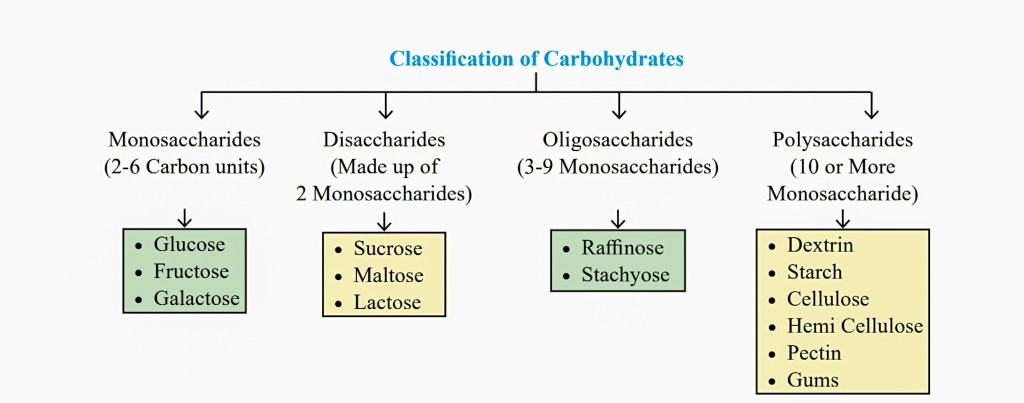
1.CARBOHYDRATES
Carbohydrates can be defined as main source of energy and present in major quantities in our foods. Carbohydrate is a chemical compound made up of elements-Carbon, Hydrogen, and Oxygen. They are joined by Phospho-diester bonds.
| Sources of Carbohydrates | Deficiency |
| Cereals and Millet | Insufficient energy |
| Pulses and Legumes | Loss of weight in adults |
| Vegetables Fruits and dry fruits | Fatigue |
| Sugar | |
| Milk & Milk products (Lactose) | |
| Muscles and Liver (Glycogen) |
Functions of Carbohydrates
1. To provide the energy- The main function of carbohydrates is to provide energy. 1 gram carbohydrate gives 4 kilo-calories
2. Protein sparing action- Insufficient amount of carbohydrate will force the body to breakdown proteins for releasing energy instead of using them for their major functions i.e. body’s growth and maintenance.
3. Utilization of fat- Carbohydrate is essential for the proper utilization of fat from the diet.
4. Role in gastrointestinal function- Carbohydrate encourages the growth of desirable intestinal bacteria and provides fecal bulk, which facilitates elimination.
5. Energy for the brain- Carbohydrates supplies glucose to the central nervous system to perform the body function.
Do you know…
The Glycemic Index (GI) is a relative ranking of carbohydrate in foods according to how they affect blood glucose levels. Carbohydrates with a low GI value (55 or less) are more slowly digested, absorbed, metabolized, and cause a lower, slower rise in blood glucose e.g. oat products.
2. PROTEINS
Protein is a complex organic compound. It contains the elements – Carbon, Hydrogen, Oxygen, and Nitrogen.
Proteins are made up of Amino Acids. Amino acids are small units or building blocks of proteins. Amino acids are joined together by chemical peptide bonds to form long protein chains.
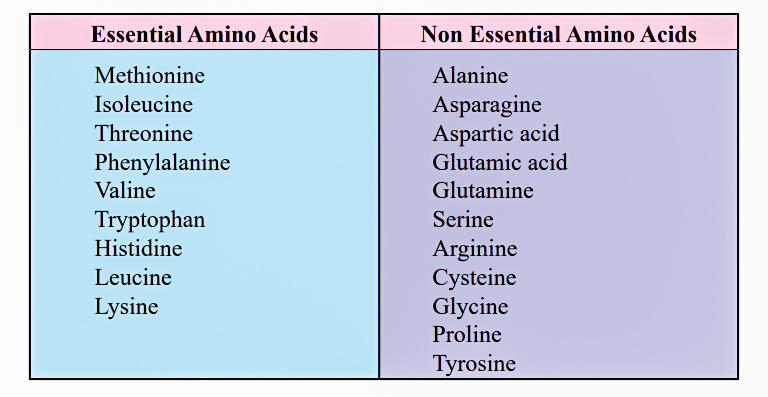
Types of amino acids. There are 2 main types of Amino Acids
- Essential Amino acid – Which we have to take from diet or outside, because they do not produced or synthesized in our body.
- Nonessential amino acid – Which are produced in our body and not necessary to take from diet or outside.
| Sources of Proteins | Deficiency |
| Pulses & Legumes | Weight loss |
| Nuts and Oil-seeds | Nutritional oedema |
| Vegetables: Peas | Muscular wastage |
| Milk and Milk products – Paneer, Cheese, Khoa | Growth retardation |
| Meat | Weakness |
| Egg | Anaemia |
| Fish | Drying of skin |
| Sparse dry, brittle and discoloured hair |
Functions of proteins
1. Protein is the main structural component of cells.
2. It supplies building blocks (amino acids) to the body.
3.Proteins are required for highly specialized metabolic functions as follows
a) Hormones and enzymes are made up of proteins which are essential for digestion and metabolic activities in the body.
b) Protein helps in making natural antibodies defense against infection to increase our immunity power.
c) Haemoglobin (found in the blood) is a protein that carries oxygen.
4. Proteins provide energy to the body if carbohydrates are less. Each gram of protein gives 4 kilo-calories.
5. Proteins are a very important component for muscle building and body growth
Do you know…..
Complete protein or whole protein is a food source of protein that contains an adequate proportion of each of the nine essential amino acids necessary in the human diet. Examples of single-source complete proteins are eggs, red meat, poultry, fish, milk, cheese, yogurt.
Incomplete Proteins are Plant foods are considered incomplete proteins because they are low or lacking in one or more of the essential amino acids necessary in the human diet. Incomplete proteins found in plant foods can be mixed to make a complete protein e.g. rice and pulses.
3. FATS AND LIPIDS
Fats or lipids can be defined as largest groups of organic compounds, which are important for the body. Fat is a more concentrated form of energy.
It contains Carbon, Hydrogen, and Oxygen. The simplest form of fat is fatty acids. Fat is a complex molecule consisting of a mixture of three fatty acids and alcohol generally glycerol.
| Sources of Fats & Lipids | Deficiency |
| Edible nuts and oil-seeds. | Deficiency of fat may lead to deficiency of fat soluble vitamins. |
| Vanaspati ghee (Plant Fats) and margarine | Fats provide essential fatty acid (EFA) which may lead to permanent learning defects. |
| Whole milk and milk products. | |
| Pork | |
| Egg yolk | |
| Poultry |
Functions of fats
1. Fats are the richest source of energy and 1gm of fats provide 9 Kilo-calories.
2. Fat is a carrier of fat-soluble vitamins A, D, E, K, P in the body and helps in their absorption.
3. Fat provides padding/coating around the vital organ such as kidney, heart which serves to hold them in position and protect them from physical shock (shock absorbers)
4. Fats serve as an insulating barrier against cold and thus helps to conserve body heat and regulate body temperature.
5. Fat increases the taste of food. Fat tends to leave the stomach relatively slowly which helps to delay the onset of hunger and gives a feeling of satiety.
6. Fat/oil also supply omega fatty acids.
Do you know…
Eating less fat or too much fat is only harmful to our body. An adequate amount of fats are essential to perform vital functions given above
FOLLOW US ON


Very helpful
LikeLiked by 1 person
Very good information
LikeLike
very informative information
LikeLiked by 1 person