
Definition of microbial analysis
A Microbiological analysis of food products is the use of biological, biochemical, molecular or chemical methods for the detection, identification or enumeration of microorganisms in a Food material
Why microbial analysis is done ?
To ensure food safety and quality, food samples
require certain microbiological tests to analyze microbial data of adequate accuracy and reliability within a particular time.
What is sampling ?
Microbiological sampling is conducted to test for pathogens in food products. This may be done in response to a complaint or obtain further information about food products.
The basic principles that must be addressed in sampling are as follows :
- The sample should represent the food as sold to the consumer
- Each part of a divided sample should be the truly represent the original
- The sampling process must not alter the sample in any way that might affect the analysis
- Storage and transportation of the sample must not alter the sample in any significant way – whether through contamination, loss, deterioration or any other means
DO YOU KNOW, WHY ISOLATION TECHNIQUE IS DONE IN MICROBIAL ANALYSIS ?
To study specific microorganisms, to separate them from the mixed microbial populations in which they are found &
To achieve this goal ,microbiologists use culture media and aseptic transfer techniques.
inoculation methods
- What is an inoculation in microbiology ?
- It is an introduction/addition of a very small group of cells (the inoculum) into a nutrient or culture medium
- How do you do an inoculation ?
- This is achieved first, by sterilizing all equipment and media that will be in contact with the microorganisms
- Then minimizing the air movement on the working area. Usually the work is done within the vicinity of a flame & laminar air flow machine
- Aseptic technique is required for the maintenance of pure cultures and the successful isolation of specific microorganism

Do you know ?
Pure culture : A pure culture is a culture that contains only one species of bacteria
Mixed culture: A mixed culture encompasses more than one species of bacteria
Use of Inoculation loop or Needle
- Transfer cultures from one medium to another
- To prepare bacterial smears
- To streak plates
Different methods of inoculation
- A. Inoculation of an agar slant
- Rest the inoculum gently at the lower end of the slant and withdraw it slowly upwards moving it from side to side (the surface of the agar should not be broken).
- This should leave a streak on the surface of the slant.
- B. Inoculation of an agar stab
- Using aseptic technique pick a single well isolated colony with a sterile inoculating stab needle and stab the needle several times through the agar to the bottom of the vial or tube Replace and tighten the cap.
- Make sure the tube and cap are well labeled.
- C. Inoculation of an agar plate
- In case of agar plates there is a greater surface area of sterile media that can be exposed to contamination in the atmosphere
- The key is to keep as much of the lid over (covering) the open agar plate as possible
- Incubate the plates at appropriate temperature and time in a incubator.
- Never open the lid on the lab bench when in an open contaminating environment
Enumeration of Microorganisms by qualitative and quantitative
Isolation techniques in microbiology
To study microorganisms in food samples, it is necessary to isolate them as mixed population and individual species. For isolation and cultivation of these microorganisms basic laboratory apparatus are required.
First of all, samples are taken from the food source which needs to be tested. These samples if are not going to be analyzed immediately are then stored at preferably at 0-4 ℃ in sterile containers.
- What are the three isolation techniques ?
- Serial Dilution
- Pour Plate Method
- Spread Plate Method
1) Serial dilution :
- It is an isolation technique which starts with a diluted sample
- For microbial analysis, samples are then diluted by serial dilution method to get the microbial count.
- Serial dilution involves taking a sample and diluting it through a series of standard volumes of sterile diluent, e.g. distilled water or 0.9 % saline.
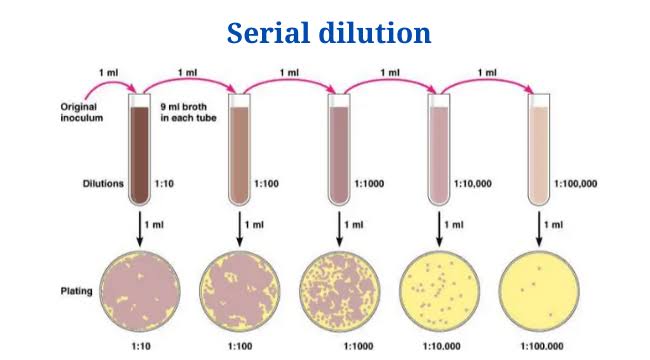
PROCEDURE
- Take a sterile pipette
- Draw up 1 ml of a well-mixed sample/culture into the pipette.
- Add this sample to the first tube. The total volume of this tube should now be 10 ml. This provides an initial dilution of 10–1
- Mix the dilution thoroughly, by emptying and filling the pipette several times.
- Take a new pipette and draw 1 ml sample from 10–1 dilution and place it in the second tube which all ready contains 9 ml of diluent
- Mix well as before. This gives a 10–2 dilution
- Repeat this for the remaining tubes, removing 1 ml from the previous dilution and adding it to the next 9 ml of diluent
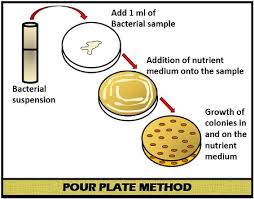
2) Pour plate method :
- A pour plate is one in which a small amount of inoculum from broth culture is added by pipette to the center of a Petri-dish
- Molten, cooled agar medium in a test tube or bottle is then poured into the Petri dish containing the inoculum.
- The dish is gently rotated clock wise for three times and anti-clock wise once
- This ensure that the culture and medium are thoroughly mixed and the medium covers the plate evenly
- Pour plates allow micro-organisms to grow both on the surface and within the medium
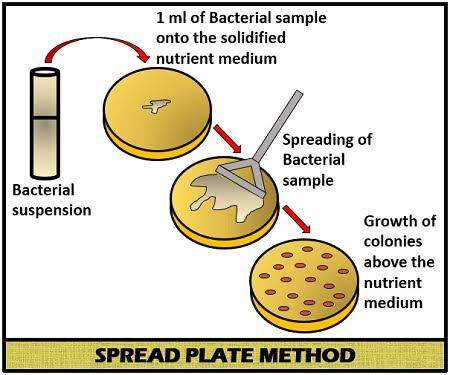
3) Spread plate method :
- Spread plates, also known as lawn plates, should result in a culture spread evenly over the surface of the growth medium
- This means that they can be used to test the sensitivity of bacteria to many antimicrobial substances, Eg. mouthwashes, garlic, disinfectants and antibiotics.
- The spread plate can be used for quantitative work (colony counts) if the inoculum is a measured volume, usually 0.1 ml, of each of a dilution is delivered by pipette.
- The sample is then spread using a spreader
| Advantages | Disadvantages |
|---|---|
| Enumeration of all the microbes is not possible | The sample volume analyzed routinely is a maximum of 0.1 ml |
| Strictly aerobic organisms are favored because colonies grow on the agar surface | Scoring of typical colonies not always easy |
Plating and counting procedure :
- Use a known volume of each dilution in plating
- By starting with the highest dilution. For statistical purposes, replicate plates should be prepared
- After incubation the plates will show a range of numbers of colonies
- Choose the plate that has an easily countable number (about 30–300) and carefully count every colony
- Used a marker pen helps to avoid counting the same colony twice.
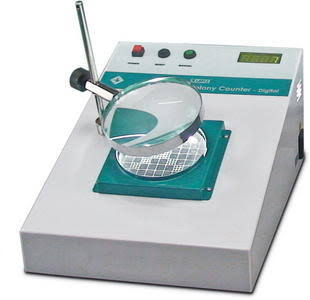
- Then calculate the number of micro-organisms in the sample by using Colony counter machine
How to calculate microbial load ?
Number of microbes/ml = number of colonies × dilution of sample
Conclusion
the sampling of food samples for microbial analysis, its enumeration and methods for isolation of pure culture for further studies. These methods are common for the isolation of beneficial organisms and spoilage organisms. The methods have been standardized over a period of time and are consistent. It depends on the skill of the microbiologist to isolate the right organism. The sampling and its preservation is one of the most important step to isolate the organism of choice, as it can lead to wrong results. However, if all the procedures are followed meticulously it is easy to isolate and preserve an microorganism.
Get in Touch
Want free access to all expensive e-books ! Subscribe us and connect us Now !!
Email – foodtech101web@gmail.com
Follow Us ON…..
Study Material – 1. https://www.youtube.com/watch?v=Zo4nqPRKbyI 2. https://www.youtube.com/watch?v=WLaijPw50W8 3. https://www.youtube.com/watch?v=0yDjEZdJZFE 4. Books – Faizer’s Food Microbiology
 Food Tech 101